

“We decided to measure and reveal the minimum response times of flagship smartphones from top manufacturers,” TouchMarks reports. “Are Apple’s touchscreens more responsive than Android devices as Apple lovers claim? Or does Samsung save its best displays for its own use?”
“Using a combination of high frame rate cameras capturing at 240fps and custom Agawi hardware, we can accurately measure the App Response Time (ART), which we define as the latency from the time the user feels that they’ve touched the device’s display to the time the user sees a response on the screen,” TouchMarks reports. “For TouchMarks I, we wanted to measure the minimum response time an app developer could expect on various devices. We built simple, optimized apps to flash the full screen white as quickly as possible in response to a touch. The apps contain minimal logic and use OpenGL/DirectX rendering to make sure the response is as quick as possible. Since these are barebones native apps doing nothing more than filling the screen in response to a touch, this benchmark defines the Minimum App Response Time (MART) a user could experience on a mobile app on each device.”
Here are the results:
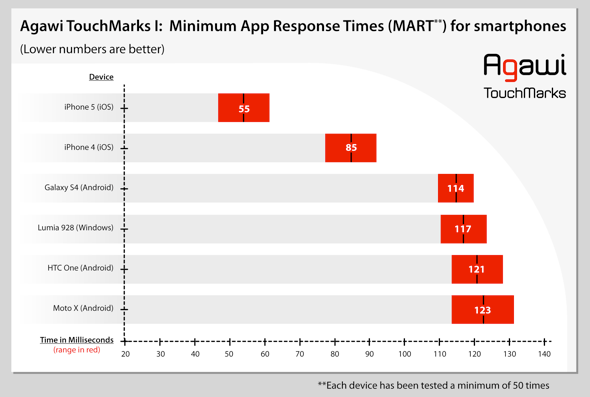
“As you can see, the results are remarkable,” TouchMarks reports. “At a MART of 55ms, The iPhone 5 is twice as responsive as any Android or WP8 phone tested. All the Android devices’ MARTs fell in the same 110 – 120ms range, with the WP8-based Lumia 928 falling into that bucket as well”
“There are several possible reasons for this. Since touchscreen hardware has significant latency itself (check out this video from Microsoft Research for a visual demonstration), our best guess at Agawi is that Apple’s touchscreen hardware is better optimized or more sensitively calibrated for capturing and processing touch. Another possibility is that while the Android and WP8 code are running on runtimes (Dalvik and CLR respectively), the iPhone code is written in closer-to-the-metal Objective-C, which may reduce some latency,” TouchMarks reports. “Regardless of the reasons, the conclusion is clear: the best written apps on iPhones will simply feel more responsive than similar apps on the current gen of Android devices. (We speculate this might be a major reason why the iPhone keyboard generally feels better than the Android keyboard to many people.)”
Read more in the full report here.
MacDailyNews Take: Why settle for a laggy, malware-prone knockoff when you can have a real iPhone instead?
[Thanks to MacDailyNews Readers “Brawndo Drinker” and “farkas” for the heads up.]
Related articles:
Apple destroys smartphone sales record: First weekend iPhone sales top nine million units – September 23, 2013
Apple’s new iPhone 5s and iPhone 5c arrive in stores on Friday, September 20th – September 17, 2013
Engadget reviews Apple iPhone 5c: A breath of fresh air that will be wildly popular this holiday season – September 18, 2013
Apple’s 64-bit iPhone 5s is by far the fastest smartphone in the world – September 18, 2013
Ben Bajarin: Apple’s new iOS 7 will cause consumers to discover their iPhones all over again – September 18, 2013
John Gruber reviews Apple iPhone 5s: ‘This is what innovation, real innovation, looks like’ – September 18, 2013
AnandTech reviews iPhone 5s: Apple’s 64-bit A7 is seriously impressive – September 18, 2013
TechCrunch reviews Apple iPhone 5s: The best smartphone available – September 18, 2013
Apple’s new iPhone 5S likely to be in exceptionally short supply – September 18, 2013
USA Today’s Baig reviews Apple iPhone 5s: ‘Makes the best smartphone even better’ – September 18, 2013
Mossberg reviews Apple iPhone 5s: ‘The best smartphone on the market’ – September 18, 2013
iPhone 5s pre-orders quickly sell out in China; gold iPhone 5s sells out quickest of all – September 17, 2013
Apple’s new iPhone 5s and iPhone 5c arrive in stores on Friday, September 20th – September 17, 2013