
comScore, Inc. today released data from the comScore MobiLens service, reporting key trends in the U.S. smartphone industry during the three month average period ending June 2013. Apple ranked as the top smartphone manufacturer with 40 percent OEM market share, while Google Android led as the #1 smartphone platform with 52 percent platform market share.
Smartphone OEM Market Share
Nearly 142 million people in the U.S. owned smartphones (59 percent mobile market penetration) during the three months ending in June, up 4 percent since March. Apple ranked as the top OEM with 39.9 percent of U.S. smartphone subscribers (up 0.9 percentage points from March). Samsung grew its share 2 percentage points with the release of its new Galaxy S4 model, ranking second with 23.7 percent market share. HTC ranked third with 8.5 percent, followed by Motorola with 7.2 percent and LG with 6.6 percent.

Smartphone Platform Market Share
Android ranked as the top smartphone platform in June with 52 percent market share, followed by Apple with 39.9 percent (up 0.9 percentage points), BlackBerry with 4.4 percent, Microsoft with 3.1 percent (up 0.1 percentage points) and Symbian with 0.3 percent.
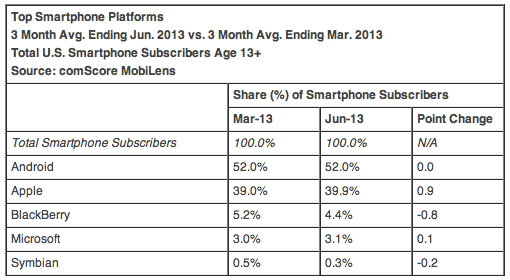
Source: comScore, Inc.
MacDailyNews Take: This is without a new iPhone since last September, no less.

All I know is that when I’m where a lot of people have their phones out, such as at airports, most of ’em are iPhones, with a smattering of “other” generally nondescript phones which I cannot specifically identify
Of course you won’t see Android users in an airport…they can’t afford to fly (except on those rare occasions when the airlines run a 2-for-1 deal).
Being an iPhone user myself I tell you: It’s this kind of insulting and socially arrogant comments that makes us look bad.
Ditto
Do you fly into any city with less than a million inhabitants?
Do you frequent any part of the planet that has no high speed internet? Or where there is only one or two mobile phone providers, tops?
Do you even know how the other 6 billion people on the planet live? Apple doesn’t even serve them, and unlike Steve Jobs with the whole family of iPods for the whole world to enjoy, Cook thinks that everyone will just save up months, if not years, of their savings to own an iPhone. If Apple wants to be relevant in future decades, it’s going to have to serve the mass market. It will not survive by going it alone. Porsche didn’t.
Yes, but Android grew its malwear by 40% last quarter, so…. It’s kinda like a tie, isn’t it?
“malwear” — good term for poorly designed wearable computing
The general term for Google Glass.
It should be noted that ComScore only shows cumulative figures for all currect mobile subscribers. It means that tendencies are shown not in absolute numbers, but in the differentials.
For the calendar Q2 Samsung added twice more “smartphone” subscribers in USA than Apple: 2% versus 0.9%.
I mentioned “smartphone” in inverted commas because most of those devices are cheap replacements for featurephones that never end up used as actual smartphones.
Nonetheless Samsung sells more phones than Apple overall, and since they replace basically all of their phones with “smartphone” variants, they grow “smartphone” marketshare faster than Apple.
“Inexpensive” iPhone that will start selling next month may help Apple with quantity growth.
Eventually, though, Samsung will claim nearly all of their 100+ million per quarter phones as “smartphones” — however ridiculous it would be.
good points, DeRS. One would think Apple would be a bit quicker to stem the trend.
As I recall, US automakers laughed at the first Japanese auto imports too. But, strategically starting with the young, price-sensitive market and moving up — and yes, copying anything and everything — those automakers now dominate entire classes of the industry.
Apple and its fans would be wise to keep the hubris in check and instead stem the tide with a full family of iPhones.
By the way, you can see the difference between “smartphones” and smartphones if you compare Apple’s share in cellular providers smartphone subscriptions: they have about 60%, while all the others, combined, have 40%. This means that of Samsung’s “smartphones” only about a quarter are actual smartphones.